
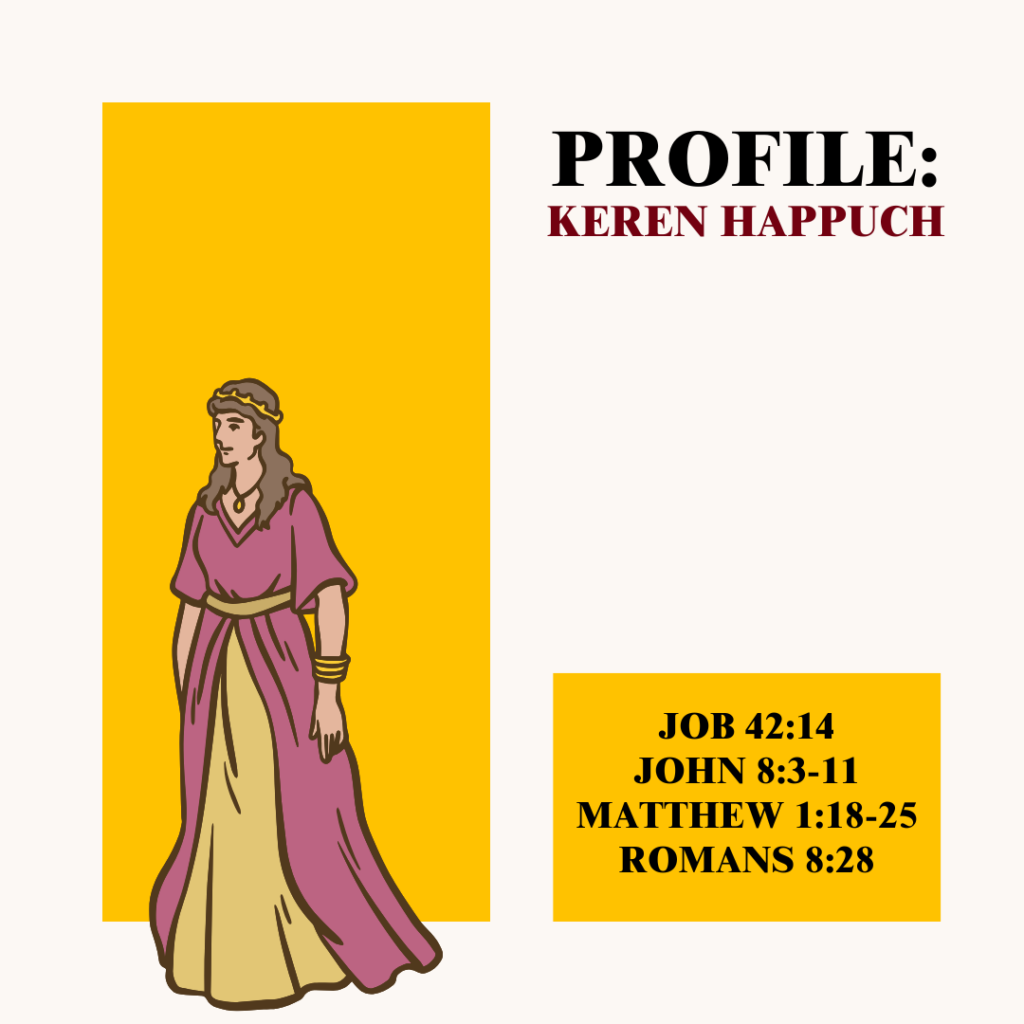
Profile: Keren Happuch
Now, let’s do a profile on Keren’s life.
Quick Facts
Parents: Job, Dinah
Siblings: Keziah, Jemima
Let’s look at the LOGOS “divine reason or word of God.”
Keren-Happuch
It’s pronounced Keren or Karen.
Really! I did not know that there was a Keren in the Bible.
Keren-Happuch was the youngest of the three beautiful daughters of Job, named in the Bible as given to him in the later part of his life after God made …Job prosperous again; Job 42:14.
Keren-Happuch and her sisters were described as more beautiful than all the other women in the land. Also, unusually and in common with her sisters, Keren-Happuch was granted an inheritance by her father, with her brothers, as might have been expected (Job 42:15). Apart from these brief references at the end of the Book of Job, she is not mentioned elsewhere in the Bible.
I’ve always been fascinated by names and what they mean.
What is the biblical meaning of Keren?
The name Keren finds its origins in the Hebrew language and holds deep significance. In Hebrew, Keren means horn, ray, beam, or strength/power. This name is rooted in ancient biblical texts and has been utilized throughout history as a symbol of power and vitality.
What is the spiritual meaning of Karen?
Karen means “pure,” which points to the wonderful innocence of childhood and the loving, pure nature baby embodies.
The shortened version appears to have originated in Denmark during medieval times, with the associated meaning of purity of heart and soul.
What did we learn from this Bible character?
Keren Happuch’s mother, whose name is Dinah, was RAPED.
The story of Dinah recounts an episode in which the girl (or young woman) goes out to see the “daughters of the land” (Genesis 34:1) but is raped, seduced, and/or abducted by Shechem, a Hivite prince, who subsequently falls in love with her. Shechem asks his father, Hamor, to negotiate marriage terms; Gen 34:7. But she is vindicated.
Genesis 34
Shechem violated and dishonored Dinah by forcing her to engage in sexual relations with him. From Genesis 34:1–3, we can identify the principle that lusting after others shows a lack of love and respect for them. This can lead to committing very serious sins.
Here comes the RHEMA WORDS “spoken word of God.”
Whenever I read this story, I often wondered what happened to Dinah after being raped. Was she unloved and rejected by men? Because back then, chastity and sexual purity were a big deal. If you weren’t a virgin, you could be stoned or disowned. Such is the case of the woman caught in adultery; John 8:3-11. And the Virgin Mary; Matthew 1:18-25. Joseph wanted to disown Mary for not keeping the vows of purity. Joseph was a righteous man who didn’t want to disgrace Mary, so he considered divorcing her.
But thanks be to God that Joseph listened to the angel and took Mary as his wife.
I was worried for Dinah after reading her story. But I’m at peace now, knowing that Dinah’s life turned out okay because she became Job’s wife.
Even though she was damaged💔goods, God provided a man who wanted her anyway. Say it with me: Love covers a multitude of sins; 1 Peter 4:8. God worked it all for good; Romans 8:28.
I could just imagine the conversation. Dinah is trying to tell Job that she was raped; you don’t want me. And Job looks back at her and says, “Girl, as you know, I lost everything; I’m just glad to have someone in my life….let me love you.”
I always wondered why she said, “cursed God and die; Job 2:9.
And it dawned on me that when bad things happen to good people, You find yourself wanting to say, why don’t you curse God and die? Blame God, so to speak. He’s the reason why all these bad things are happening to you. You find yourself saying. If you remember, she was raped while trying to be a good girl. I guess she was trying to tell Job. Here you are, trying to be a good man, and still, bad things are happening to you; why don’t you curse God and die?
What I like about Job. He did not blame God; Job 2:9-13. So, even after all that happened to Job, he did not sin. He did not accuse God of doing anything wrong.
Anyways, back to Keren-Happuch
being the youngest sibling.
What can we learn from the youngest child?
From the youngest child, we can learn to be adaptable, resilient, creative, often good at social interaction, and comfortable seeking help when needed, as they often have to navigate a world where older siblings have already established routines and may need to be more resourceful to get attention or participate fully; they also tend to be more observant and may pick up on skills by watching others around them.
Key takeaways from being the youngest child:
Adaptability:
Always adjusting to new situations and being comfortable with change due to being surrounded by older siblings at different life stages.
Observational skills:
Learning by watching and imitating older siblings, picking up on strategies and life lessons.
Social skills:
Often developing strong social skills to fit in with a group of older peers.
Creativity:
Finding unique ways to get attention or participate, leading to creative thinking.
Resilience:
Learning to bounce back from challenges and not always being the center of attention.
Confidence building:
May need to be assertive to get their needs met, leading to a confident personality.
Asking for help:
More likely to seek guidance from others due to less experience.
What can we learn from youngest child in the “Bible?
Bible teaches that children are made in God’s image and have immeasurable worth. We can learn from children in the Bible to be humble, rely on God, and have faith.
Humility
Children’s innocence and purity
Some say that babies are closer to God because of their innocence and purity.
Children’s simple faith
Children run to Jesus because they are drawn to him, without feeling like they need to offer anything.
God works through the unexpected
God tends to work through the weak, the disenfranchised, and the unexpected.
Relying on God
Children’s posture: Children may live with more imagination and whimsy than adults.
Children’s vulnerability: Children can teach us that we have much to learn from those who are vulnerable.
Faith
Children’s closeness to God: Jesus said, “Verily I say unto you, whosoever shall not receive the kingdom of God as a little child shall in no wise enter therein” (Luke 18:17).
So, if you are the youngest child in your family, consider that a blessing.
What can we learn from an older child?
Some things we can learn from comparing older and youngest children include:
Learning
Older children can teach younger children how to care for others, solve problems, and develop empathy and kindness.
Personality
Older children may be more perfectionist, reliable, and conscientious, while younger children may be more rebellious, fun-loving, and creative.
Development
Older children may have cognitive development advantages, such as verbal development, reading, and literacy skills.
Social skills
Older children can develop soft skills, such as empathy, kindness, and creativity, through playing with younger children.
Independence
Younger children may be more independent and have more freedom.
Attention
Youngest children may get a lot of attention from their parents and older siblings.
Expectations
Older siblings may be more motivated to live up to their parent’s expectations, while younger siblings may be less worried about meeting those expectations.
In conclusion,
God values character and obedience over birth order and can use the unexpected to achieve his purposes; prominent examples include Jacob over Esau, David over his older brothers, and Joseph being favored over his siblings, teaching us that God can elevate the seemingly less likely and that true greatness comes from faithfulness, not just position.
Giving you a brief synopsis…
Bible Study Student:
What did the Holy Spirit reveal to you about this Bible character? What’s going to be your preaching and teaching message after reading Keren-Happuch’s profile?

Welcome, I'm Karen!
Hello friend! Writing has been my passion since I was nine. Winning my first writing contest at that young age inspired me to keep improving my skills. Fast forward to when I was 22 years old when I experienced a profound spiritual awakening that led me to become a devout Christian. From that point on, I knew that I wanted to use my writing abilities to spread the word of God and positively impact the world.
- Over the past 30 years, I have poured myself into my writing, producing a wide range of content that spans from letters to prisoners and newsletters to newspaper articles, books, and social media posts.
- For the past four years, I have even been contributing to the Churchome App, sharing my thoughts, insights, and experiences with the wider Christian community.
- I am particularly proud of my latest books, "Let's Make Love, Then Cook. It's Not What You Think" and "It's Just Good Housekeeping."
- "Let's Make Love, Then Cook. It's Not What You Think" is about loving God, loving people, and serving people.
- "It's Just Good Housekeeping." is about finding an attractive way to encourage everyone to read their Bible because reading the Bible has an impact on keeping our lives clean and pure.
These books are a testament to my love of writing, as well as my commitment to using that writing to inspire, inform, and entertain people from all walks of life.